
Chasing cheap shipping from China often feels like a smart way to reduce logistics costs. Lower freight rates usually improve short-term margins and make pricing more competitive.
Cependant, in real import operations, the lowest quote rarely reflects the final landed cost. At Niuku Logistique, we often see importers selecting the cheapest option first, only to discover additional costs later in the process.
In international logistics, pricing does not stay fixed from origin to destination. Plutôt, costs evolve as cargo moves through ports, customs, and final delivery stages. Par conséquent, cheap shipping from China can quickly become unpredictable and more expensive than expected.
Hidden Destination Charges Behind Cheap Shipping
Many freight quotes from China look extremely attractive at the origin stage. Some even appear 10–30% lower than market average, which makes them seem like a smart decision.
Cependant, this is where hidden cost structures begin to appear.
Once the cargo arrives at the destination port, the real charges start to surface. To win bookings upfront, some low-cost carriers exclude or separate key destination fees, y compris:
- Destination Terminal Handling Charge (DTHC)
- Customs Clearance Fees
- Port Storage and Congestion Charges
- Inland Trucking and Delivery Costs
Industry Reality
When combined, these hidden costs can increase the total landed cost by 20% à 60%, especially during peak season congestion.
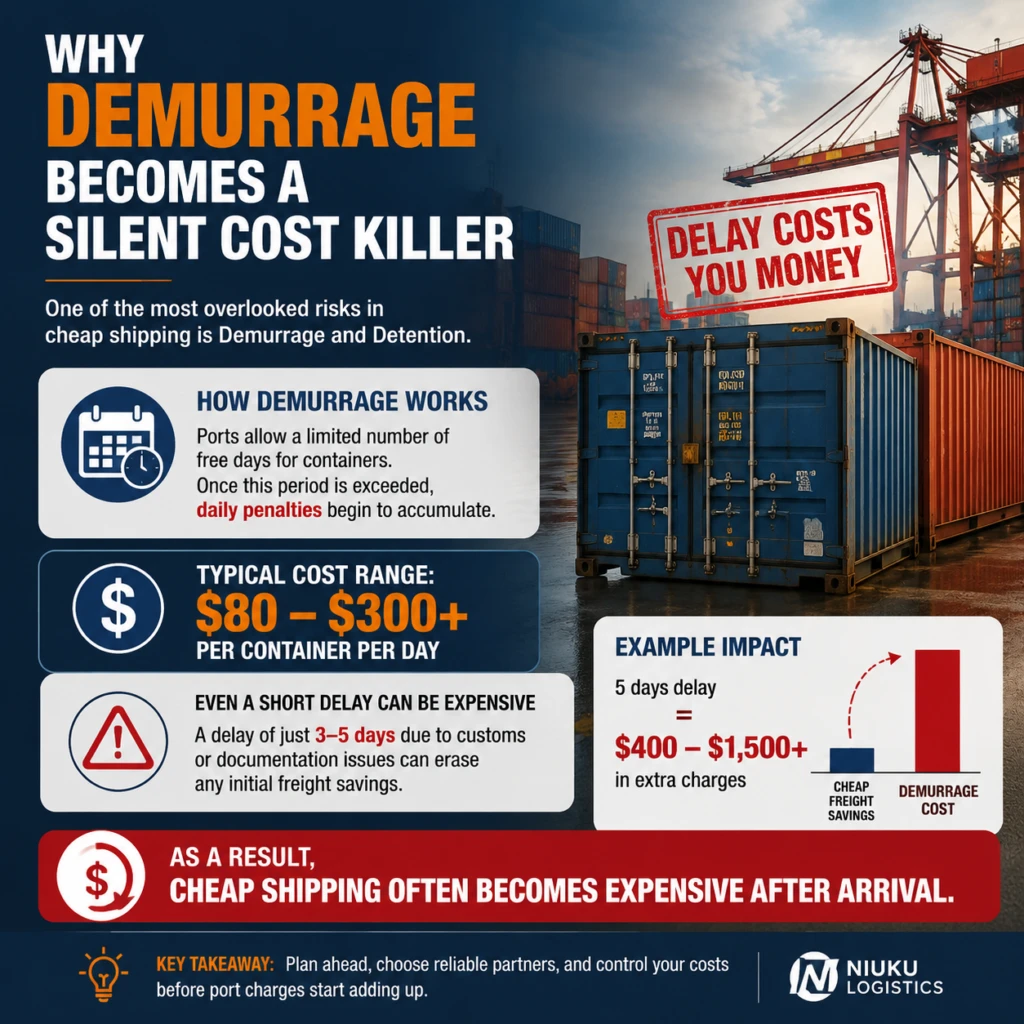
Why Demurrage Becomes a Silent Cost Killer
One of the most overlooked risks in cheap shipping is Demurrage and Detention.
In simple terms, ports allow a limited number of free days. Once this period is exceeded, daily penalties begin to accumulate.
Typical cost range:
- $80–$300+ per container per day
Even a short 3–5 day delay caused by customs or documentation issues can erase any initial freight savings.
Par conséquent, cheap shipping often becomes expensive after arrival.
Why Cheap Shipping from China Causes Delays
Low-cost shipping usually receives lower priority in carrier allocation. Shipping lines assign space based on contract level and freight rate.
Donc, low-price shipments often face:
- Rolled containers during peak season
- Missed sailing schedules
- Limited space allocation
- Slower routing decisions
Real-world comparison:
- Fast premium service (e.g., Matson line)
- Transit time: 11–14 days
- On-time rate: 90%+
- Low-cost standard ocean freight
- Transit time: 18–35+ days
- Higher risk of delays and rollover
Customs Risks in Low-Cost Freight
Another major risk comes from customs clearance.
To reduce pricing, some providers simplify documentation or reduce compliance checks. Cependant, this increases inspection probability.
Common issues include:
- Incorrect HS codes
- Under-declared values
- Missing invoices
- Inconsistent shipment data
Once flagged, customs delays often lead to storage fees, additional inspections, and unpredictable clearance timelines.
Why Freight Quotes Are Often Misleading
Many low freight rates look competitive because they exclude key service components.
In most cases, excluded items include:
- Insurance coverage
- Destination handling services
- Full routing control
- Real-time shipment support
At first glance, the price appears lower. Cependant, the service scope is significantly reduced.
Donc, experienced importers focus on total landed cost, not headline freight rate.
How Cheap Shipping Becomes More Expensive
When hidden costs accumulate, the impact becomes clear:
- Unexpected destination invoices
- Storage and demurrage charges
- Inventory arrival delays
- Lost sales opportunities due to stockouts
In many cases, the cheapest option becomes the most expensive decision.
How to Avoid These Risks
Choosing cost-effective logistics does not mean selecting the highest price provider. Plutôt, it requires transparency and structured planning.
Before confirming any shipment from China, always verify:
| Check Point | Key Question | Risk Avoided |
|---|---|---|
| Price Structure | Is this an all-in rate? | Hidden destination charges |
| Trade Terms | DDP or DDU? | Unexpected tax liability |
| Carrier Route | Which shipping line is used? | Delay and rollover risk |
| Peak Season Stability | What is the space guarantee? | Inventory disruption |
At Niuku Logistics, we recommend confirming full landed cost visibility before booking any shipment.
Strategic Insight
The biggest mistake importers make is optimizing for origin cost instead of system cost.
In modern logistics, efficiency depends on:
- Predictable delivery timelines
- Transparent cost structures
- Stable customs processing
- Controlled last-mile delivery
Once these factors are aligned, logistics becomes a strategic advantage rather than a cost burden.
Conclusion
Cheap shipping from China is not inherently risky. The real problem arises when pricing lacks transparency and critical cost elements are hidden.
In global logistics, the lowest freight rate rarely equals the lowest total cost. Plutôt, visibility and structure determine the real efficiency of cross-border shipping.
Understanding what is included in a freight quote is essential for making stable, predictable, and cost-effective import decisions.
Appel à l'action
Niuku Logistique provides transparent all-in freight solutions from China to the USA, covering origin handling, international transport, dédouanement, et coordination de la livraison finale.
No hidden fees. No unexpected charges.