
Pour de nombreuses entreprises de commerce électronique en croissance, un entrepôt de traitement des commandes de commerce électronique au Canada ressemble au départ à une simple configuration opérationnelle.
Les commandes sont expédiées normalement. Les délais de livraison semblent acceptables. Les clients continuent de recevoir des colis sans plaintes majeures.
Les coûts logistiques commencent alors à augmenter plus vite que prévu.
D'abord, la plupart des vendeurs supposent que le problème vient du prix du coursier. Ils essaient de changer d'opérateur, négocier des tarifs de colis inférieurs, ou mise à niveau des services d'expédition pour améliorer la vitesse de livraison.
Pour une courte période, ça marche parfois.
Mais une fois que le volume des commandes augmentera dans plusieurs provinces canadiennes, la même pression d'exécution revient généralement.
L’expédition de Vancouver à Toronto semble toujours chère. Les retards de livraison en haute saison continuent d'apparaître. Certains entrepôts manquent de stocks tandis que les stocks restent surstockés dans d'autres régions..
Finalement, de nombreuses entreprises réalisent que le problème ne réside pas simplement dans la tarification des transports.
Le vrai problème est que leur Entrepôt de traitement des commandes de commerce électronique au Canada la stratégie n’a jamais été conçue pour la distribution des commandes à l’échelle nationale en premier lieu.
Pourquoi les expéditions transfrontalières deviennent coûteuses si rapidement
La géographie du commerce électronique au Canada fonctionne très différemment des petits marchés.
La population est dispersée sur d'énormes distances, alors que le prix des colis est fortement influencé par les zones de livraison.
Cela signifie qu'un colis expédié à travers les provinces peut coûter beaucoup plus cher qu'une livraison locale dans la même région..
Par exemple:
- Une livraison à Toronto peut rester relativement abordable
- Un envoi envoyé de la Colombie-Britannique vers l'Ontario peut coûter deux ou trois fois plus cher
- Les produits surdimensionnés deviennent encore plus chers en haute saison
Cela devient de plus en plus difficile pour les entreprises qui vendent via:
- Amazone Canada
- Marché Walmart
- Boutiques Shopify
- Boutique TikTok
- Marques de commerce électronique destinées directement aux consommateurs
Alors que les commandes à l’échelle nationale augmentent, de nombreux vendeurs découvrent qu'ils dépensent plus d'argent pour essayer d'« expédier plus rapidement » au lieu de corriger la structure réelle des stocks derrière l'exécution..
La plupart des vendeurs ne réalisent pas le problème au début
Quand les frais de livraison commencent à augmenter partout au Canada, la plupart des vendeurs ne pensent pas immédiatement à la stratégie d'entrepôt.
La première réaction est généralement:
Trouver un coursier moins cher.
Alors ils commencent à basculer entre UPS, FedEx, Postes Canada, et sociétés de livraison locales, en espérant que des tarifs de colis plus bas résoudront le problème.
Pour une courte période, ça marche parfois.
Ensuite, le volume des commandes augmente encore.
Soudainement, le même problème revient.
L’expédition de Vancouver à Toronto semble toujours chère.
Des retards en haute saison se produisent encore.
Les services de livraison plus rapides ne font qu'augmenter encore les factures d'expédition.
À ce point, de nombreux vendeurs commencent à réaliser quelque chose d'important:
Le problème ne vient pas du courrier lui-même.
Le problème est que chaque commande continue de voyager à travers le pays à partir du même entrepôt..
Un transporteur moins cher peut réduire légèrement le prix.
Mais cela ne peut pas réduire la distance entre l'inventaire et le client..
C’est généralement à ce moment-là que les entreprises commencent à repenser leur structure de traitement des commandes au lieu de simplement changer de prestataire de livraison..
Pourquoi de plus en plus de vendeurs s'orientent vers la distribution multi-entrepôts
Une fois que les entreprises reconnaissent le placement des stocks comme le véritable problème, le traitement des commandes dans plusieurs entrepôts commence à prendre un sens opérationnel.
Au lieu de stocker tous les produits dans une seule ville, les stocks sont distribués plus près de la demande des clients régionaux.
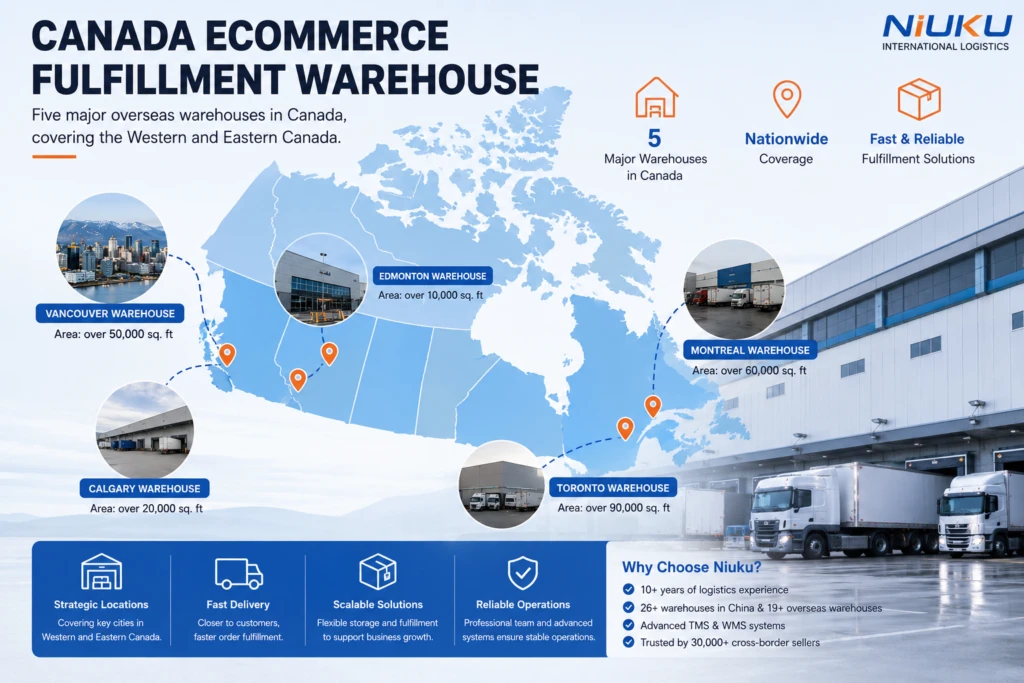
Niuku International Logistics exploite actuellement des entrepôts de traitement des commandes dans les principales régions logistiques canadiennes, y compris:
- Toronto
- Montréal
- Vancouver
- Calgary
- Edmonton
Cette structure d'entrepôt aide les entreprises à réduire les mouvements inutiles de colis à travers le pays avant même que les commandes ne soient expédiées..
Pour de nombreuses marques de commerce électronique, l'exécution localisée peut réduire les coûts de livraison du dernier kilomètre en 30% à 60%, en fonction de la taille du produit, densité de commande, et région d'expédition.
En même temps, des itinéraires de livraison plus courts améliorent également la cohérence des expéditions pendant les pics saisonniers.
Pourquoi les vendeurs du marché ressentent la pression plus tôt
Les vendeurs du Marketplace remarquent souvent des problèmes de traitement des commandes avant les marques indépendantes..
En effet, les plateformes comme Amazon et Walmart récompensent de plus en plus des performances de livraison stables..
Une fois que les délais de livraison deviennent incohérents, les vendeurs peuvent commencer à voir:
- Des taux de conversion inférieurs
- Visibilité réduite du produit
- Plaintes des clients
- Pression de remboursement plus élevée
- Stress lié au réapprovisionnement des stocks
C'est pourquoi de nombreux vendeurs à croissance rapide positionnent désormais leurs stocks au Canada avant le début des périodes de pointe des ventes..
Au lieu de réagir après des retards, ils utilisent l'exécution régionale pour réduire la pression opérationnelle plus tôt.
Pour de nombreuses entreprises de commerce électronique, la planification des entrepôts n'est plus seulement une décision logistique.
Cela fait désormais partie de la stratégie du marché.
Pourquoi la coordination de l'exécution devient plus difficile à mesure que les entreprises évoluent
La gestion d'un entrepôt est relativement simple.
Gestion des stocks dans plusieurs provinces, fournisseurs, marchés, et les délais de livraison sont très différents.
À mesure que les opérations de commerce électronique se développent, les entreprises ont souvent du mal à:
- Visibilité des stocks
- Coordination du réapprovisionnement
- Équilibrage des stocks entre régions
- Gestion des retours
- Suivi des expéditions
Niuku International Logistics soutient plus de 30,000 vendeurs mondiaux grâce à des ressources d’entrepôt à travers le Canada, Chine, les États-Unis, le Royaume-Uni, et l'Europe.
Combiné avec les systèmes TMS et WMS intégrés, la société aide les vendeurs à améliorer la coordination des stocks dans le cadre d'opérations de traitement des commandes transfrontalières plus larges.
Conclusion
Entrepôt de traitement des commandes de commerce électronique au Canada la stratégie ne consiste plus seulement à expédier plus rapidement.
Pour les marques de commerce électronique en croissance, le problème plus important est souvent caché dans le positionnement des stocks lui-même.
De nombreux vendeurs tentent dans un premier temps de résoudre la hausse des coûts logistiques en changeant de transporteur ou en améliorant les services de livraison.. Mais une fois que le volume des commandes à l’échelle nationale augmentera, les entreprises découvrent finalement que l'exécution des commandes à l'échelle nationale devient difficile à contrôler lorsque les stocks restent concentrés en un seul endroit..
En répartissant les stocks au plus près de la demande régionale, les entreprises peuvent réduire la pression des transports, améliorer la cohérence de la livraison, et créer des opérations de traitement des commandes plus évolutives partout au Canada.
Avec une couverture d’entrepôts dans les principales régions logistiques canadiennes et une vaste expérience du commerce électronique transfrontalier, Niuku International Logistics aide les vendeurs à créer des systèmes de traitement des commandes plus flexibles et à coûts contrôlés pour une croissance à long terme